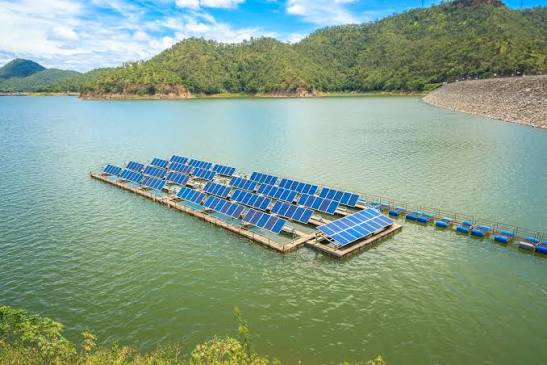
We design, build and commission floating solar on reservoirs, industrial process ponds and canal banks — with HDPE float arrays engineered for monsoon water-level swings, anchored to the bed, and wired back to a shore-side inverter and switchyard.
Floating isn't a gimmick — on the right site, it gives you land-free generation, water savings and a cooler-running module. On the wrong site, anchoring and water-level swings kill the economics. We help you tell which one you're on.
For C&I buyers who can't find or afford 10–50 acres of contiguous land near a substation, a reservoir is often already on site.
Water-cooled modules typically run 5–8°C cooler than ground-mount — translating to 1.5–3% higher specific yield in the same climate.
Floating arrays shade the water surface, cutting evaporation losses by up to 70% on covered area — useful for industrial ponds and reservoir operators.
Floating solar fails when anchoring is wrong, water-level swing isn't modelled, or the shore-side switchyard can't take the export. We handle all three.
UV-stabilised HDPE modular floats bolted into arrays, with walkways, cable trays and module mounting hardware sized for the wave and wind regime.
Bed anchoring with helical or deadweight anchors, shoreline restraint cables, freeboard calibrated for monsoon high-water and low-water extremes.
String or central inverters on a raised plinth, LT panels, transformer, RMU, and grid interconnect at the DISCOM substation.
PVSyst model adjusted for water-cooling factor, shade-aware float layout and cable length optimisation to the shore.
Module and cable materials selected to minimise leaching, periodic water testing during AMC, and access for water-quality audits.
Floating arrays need different cleaning — boat-based, low-pressure rinse cycles scheduled around generation hours, included in AMC.
We tell you honestly when ground-mount is the cheaper answer — the test is water depth, level swing, shoreline distance to grid and ownership clarity.
Stable water level (annual swing under 2–3 m), minimum depth 2 m for floats + anchorage, calm-to-moderate wind, clear ownership of water body or long-term lease, substation within a few km.
Highly seasonal water bodies, areas with extreme wave action, water bodies under fisheries or forest department jurisdiction without prior approvals, sites too far from the grid.
Share water-body type, approximate area in acres, water-level data and the DISCOM substation distance. We respond with a suitability verdict and a first-pass budget within 3 working days.
Site name, water-body type, surface area, ownership and any existing substation are the most useful bits.
If you're responding to a government or DISCOM tender for a floating solar plant, share the RFP — we'll do a technical fit assessment free of charge.